Enhancing Grazing and Biodiversity Through Precision Cutting
Vegetation Management on Gelligaer & Merthyr Common
Executive Summary
Enviroculture was appointed to deliver vegetation management across 7.67 hectares of upland common at Gelligaer & Merthyr. The works formed part of a wider programme to reduce wildfire risk, restore grazing areas, and improve biodiversity. Despite hidden rocks, fly-tipped tyres, and challenging terrain, our team successfully delivered the project on time and in full compliance with ecological and security requirements, using drone reconnaissance to plan routes and protect wildlife.
About the Client
The Gelligaer & Merthyr Commoners Association manages a large upland common in South Wales that supports livestock grazing and wildlife habitat. Through the Tân, Natur a Phobl: Building a Resilient Landscape project, funded by Welsh Government via WCVA’s Landfill Disposals Tax Communities Scheme, the association aims to reduce wildfire risk and enhance biodiversity while maintaining the area as a productive grazing landscape.
The Challenge
The site consisted of uneven, rocky terrain with several areas of historic fly-tipping. Many obstructions, including tyres and large stones, were hidden beneath dense bracken, posing risks to machinery and operatives. The open and remote nature of the site also required heightened attention to security, ensuring no equipment or fuel was left unattended overnight. Additionally, strict environmental protocols were required to prevent soil disturbance, protect habitats, and avoid disruption to wildlife in active grazing areas.
The Solution
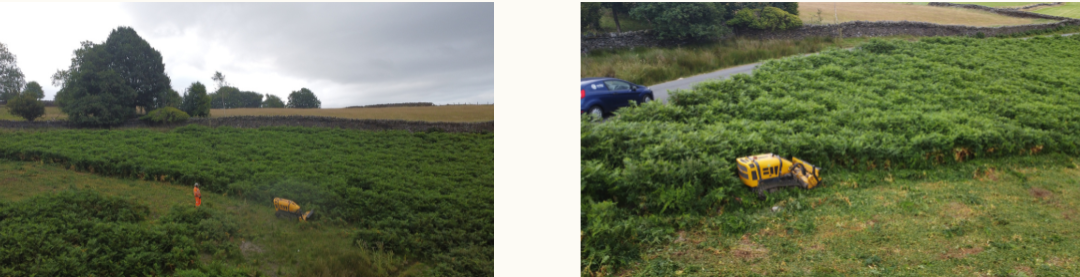
To overcome these challenges, we used drone technology to carry out aerial reconnaissance before mobilisation. The high-resolution imagery enabled us to map access routes, identify hidden obstacles, and plan efficient cutting paths. We deployed Roboflails with low ground pressure tracks, ideal for uneven upland terrain, to minimise disturbance. All machinery used biodegradable hydraulic oil, refuelling was carried out via a bunded ATV system with spill trays, and daily wildlife checks were built into our work routine to ensure no nesting birds or protected species were disturbed during operations.
The Implementation
Work began immediately after contract award. Our operatives worked systematically across ten treatment areas, cutting dense bracken to open up grazing habitat and reduce wildfire risk. Wildlife checks were completed each morning before work commenced, ensuring compliance with environmental legislation and safeguarding any nesting or foraging species identified on site.
Drone mapping guided progress and helped identify areas requiring manual clearance, including fly-tipped tyres and hidden rocks, which were safely removed before cutting. Due to the open nature of the Common and its public accessibility, security was a key consideration throughout the works. All machinery, tools, and fuel were removed from site each evening and stored securely off-site to prevent tampering or theft. Daily task planning was informed by weather and ground conditions to maintain a low environmental footprint and prevent soil damage.
Additional Projects and Challenges
The discovery of hidden rocks and debris required adaptive working methods and close communication with the client. Using drones to survey the next day’s work areas helped us identify new hazards early and adjust plans efficiently. This approach improved safety, maintained programme timescales, and enhanced ecological protection standards.
The Results
• 7.67 ha of dense bracken cut to restore open grazing habitat
• Zero wildlife disturbance or environmental incidents
• Zero equipment damage or safety issues
• All works completed within schedule
• Enhanced biodiversity and improved grazing capacity
The works successfully restored open habitats for grazing livestock, improved species diversity, and reduced wildfire risk in line with the project’s conservation objectives.
Client Testimonial and Feedback
“Enviroculture delivered an excellent standard of work under challenging conditions. Their use of drone technology, daily wildlife checks, and focus on site security ensured the project was completed safely, efficiently, and in full respect of the site’s ecological sensitivities.”
Mark Ward, Project Support Officer, Gelligaer & Merthyr Commoners Ltd
Lessons Learned
Integrating drone surveys, wildlife monitoring, and strong site security protocols ensures projects on open-access uplands are delivered safely, responsibly, and to the highest environmental standards.
Call to Action
To discuss vegetation management or habitat restoration for your upland or conservation site, visit www.enviroculture.co.uk or email info@enviroculture.co.uk.
Accreditations