
Vegetation Management, Fencing and Habitat Preparation for Conservation Grazing
Cwmmawr Field
Executive Summary
Enviroculture delivered habitat management and fencing works at Cwmmawr Field in Tumble for Carmarthenshire County Council’s Biodiversity Team under the Local Places for Nature (LPN) grant scheme. The works were carried out ahead of the bird nesting season and included cutting and collecting overgrown vegetation, clearing trees and scrub to re-establish the fence line, and repairing boundaries to prepare the site for future conservation grazing. Despite the site’s challenging conditions, including steep, wet ground and restricted access through a built-up residential area, Enviroculture successfully completed all works on time, restoring the field for wildflower regeneration and improved marsh fertility.
About the Client
The project was commissioned by Carmarthenshire County Council’s Biodiversity Team as part of their Local Places for Nature programme. The scheme focuses on restoring local habitats, supporting biodiversity, and creating spaces where wildlife can thrive. Cwmmawr Field, a former colliery site, had become overgrown and underused. The works aimed to regenerate the field for conservation grazing and enhance the site’s ecological value.
The Challenge
Cwmmawr Field presented several logistical and environmental challenges. The site was located off a busy road in a built-up area, with narrow access routes and limited space for machinery. Once on site, conditions were wet and uneven, with steep slopes along the field edges.
The field itself was dominated by long grass, bramble, and scrub, with fallen trees and abandoned round bales scattered throughout. The project required careful clearance to create a fencing route while retaining valuable scrub and woodland corridors to support wildlife and maintain natural structure.
The Solution
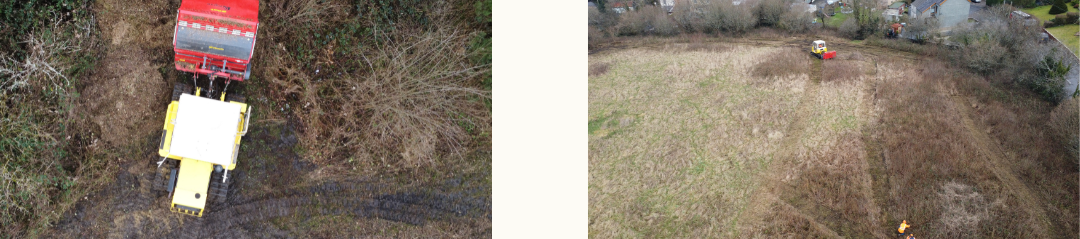
Enviroculture deployed specialist low ground pressure machinery and experienced operators to complete the works safely and efficiently:
• A low ground pressure crawler tractor with flail collector for the cut and collect operation
• A low ground pressure five-tonne excavator fitted with a post knocker for the fencing works
• A team of two chainsaw operators to clear fallen trees and smaller regrowth along the fence line
Vegetation was cut and collected across the open areas of the field, with arisings tipped around the woodland edges to create habitat piles for invertebrates and small mammals. The new fencing, installed to British Standard for livestock, was designed to allow conservation grazing while protecting retained scrub and young woodland growth.
Chainsaw teams cleared fallen trees and regrowth by hand to open a route behind the scrub, maintaining a natural woodland corridor and ensuring the site was left with varied structure rather than a uniform finish.
The Implementation
All works were undertaken before the start of the nesting season to avoid disturbance to wildlife. Cutting and collection were carried out systematically, working from higher ground toward the wetter areas at the base of the field. The collected vegetation was deposited along the field edge to create new habitat zones.
Fencing installation followed clearance, with materials and machinery carefully managed due to the tight site entrance and proximity to housing. The use of low ground pressure equipment ensured minimal soil disturbance, even in wet areas.
Old round bales and debris were removed and disposed of responsibly, leaving the field ready for future management. Areas of scrub and woodland fringe were retained to promote habitat diversity and natural boundaries.
Additional Projects and Challenges
The combination of tight access, soft ground, and nearby properties made this a particularly demanding project. Clear communication with local residents and careful coordination of deliveries were essential to maintain safety and minimise disruption.
Regular safety briefings and environmental checks ensured compliance with best practice and environmental protection measures.
The Results
• Overgrown vegetation cut and collected across the field
• Fallen trees and scrub cleared to re-establish the fence line
• New livestock fencing installed to enable conservation grazing
• Field restored to encourage wildflower regeneration and marsh fertility
• Habitat piles created around field edges to enhance biodiversity
The completed works transformed Cwmmawr Field from an unmanaged, overgrown site into a restored habitat ready for long-term conservation grazing, improving biodiversity and supporting sustainable management within a built-up community landscape.
Lessons Learned
Projects in built-up or constrained locations require careful planning and environmental sensitivity. The combination of low ground pressure machinery, selective clearance, and clear communication with stakeholders ensured a positive outcome that balanced operational efficiency with ecological value.
Call to Action
For vegetation management, fencing, and habitat restoration in challenging or sensitive environments, visit www.enviroculture.co.uk or email info@enviroculture.co.uk.
Accreditations